
Advertising disclosure
Hosting Canada is community-supported. We may earn a commission when you make a purchase through one of our links. Read Disclosure.
Shopify Review for Small Businesses in 2026




In this Shopify review, we tell you why we love it for e-commerce, big or small. We get into the pros and cons of the various Shopify plans as well as their pricing and features to help you make your decision.
Fortunately, you can try Shopify now for FREE (no credit card needed) for 3 days to see if you like it. Then test it out thoroughly for just $1 per month for the first 3 months with any of their plans.
- Full integration for selling across multiple platforms.
- Impressive inventory system.
- Scales to your business easily as it grows.
- Tons of analytic tools to help with your business.
- Robust protection and security features.
- Large ecosystem of apps and integrations.
- Excellent customer support.
- Higher subscription cost than some competitors.
- Some backend coding may be needed for more advanced capabilities.
- Some features depend on third-party apps.
- Add-ons can be expensive.
- Excellent e-commerce management capabilities.
- Multichannel publishing.
- Inventory management for both online and in-store.
- Keep track of reports and performance metrics.
- Mobile-optimized functionality.
- Various business finance tools.
Reasons Not to Use Shopify?
1) You are selling under five products and value complete simplicity over everything else.
2) Your blog was established first, and you rely heavily on WordPress (currently the most popular CMS). SEO is your bread and butter, and e-commerce is a slight afterthought.
3) You have a large budget for a custom web developer. Here’s a secret: There is a high probability of them using Shopify.
4) You want to sell on only one channel. (Hint – Shopify lets you sell on every platform easily).
If you don’t fall into any of those categories, Shopify should be one of your first choices for e-commerce hosting. However, if you’re exploring other options, you may want to check out website builder alternatives to see what else is available.
Pros – What We Like About Shopify
All the positives of Shopify add up to offering e-commerce store owners the tools they need to build and manage their stores. They are especially great for complete newbies who don’t want the hassle of learning tech when they should be focusing on their business.
The company was also founded by three Tim Hortons-loving Canadians and is headquartered in Ottawa. We have to support our country folk. 🇨🇦

Multiple Channel Selling
Shopify lets you integrate your products with marketplaces like Amazon, eBay, and Etsy.
You can also take advantage of social media channels like Pinterest, Facebook, and Instagram.
Inventory System
Shopify has a straightforward inventory system that allows you to organize and edit items without hassle.
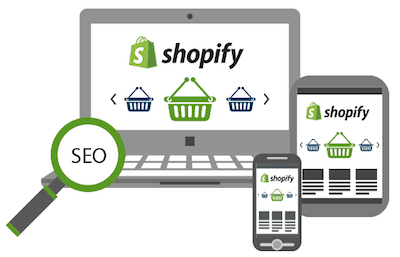
If you want, you can organize your products into collections and group them together.
This means that dealing with inventory, even from different suppliers, is a breeze.
Shopify Plans, Features, and App Store
Practically any feature that you can think of is available on Shopify.
In case you can’t find the feature you’re looking for, then check out the app store. You get to choose from a vast selection of thousands of apps that offer free and premium services.
Cons – Things To Consider
Shopify has its downsides, as most companies do. These aren’t drastic, but they’re worth noting before you decide to commit to the platform.
 Shopify Pricing
When it comes to competing e-commerce platforms, Shopify is pretty comparable to similar services. However, its prices are a bit higher than those of platforms that don’t specialize in e-commerce. Plus, there aren’t many free templates, so you may have to pay extra.
As of this writing, prices range from $29.00 USD per month to $299.00 USD per month, with major caveats depending on whether you are taking advantage of discounts, if you pay an annual lump sum, or if you pay per month. All of these factors can affect your price, so pay attention to the plan and extra features you choose.
For small businesses, $29 a month could be a lot of money – especially when sales aren’t given. There are many costs involved in starting an online business, and everything adds up.
While negligible for established businesses, the cost may feel significant for new entrepreneurs.
Backend Coding
You might encounter problems with the backend of Shopify. Sometimes you might feel overwhelmed and want to hire professional help.
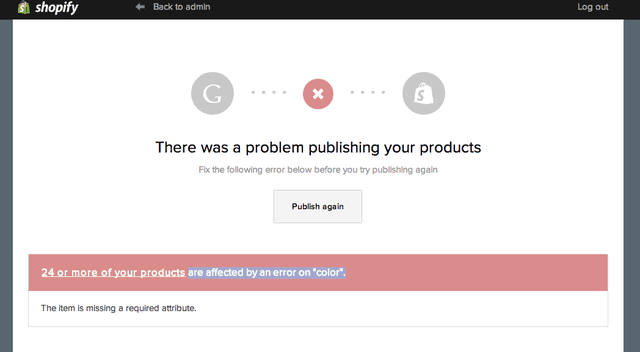
The community of Shopify users is pretty big, and often there are fixes for issues in forums, articles, and videos.
The good thing is that, with the proliferation of the Shopify ecosystem, there are tons of online tutorials for literally anything Shopify-related. If you’re willing to put in some elbow grease and get into it, you can easily DIY your own shop.
That said, Shopify has become more beginner-friendly, especially with the advancement of its AI features, such as Sidekick and its AI website builder. You can get a lot done with less tech know-how. However, with a little knowledge, you can really fine-tune your store.
Customer Support
This Shopify POS review wouldn’t be complete without talking about customer support.
Something that goes along with this is that they will send you a credit card reader when you sign up, so you can sell your goods in person. This convenient and rare offering is easy to set up, but their customer support can walk you through the process if needed.
Beyond that, their support staff is available 24/7 to help with any concerns or questions. For users in higher payment tiers, they even assign you a specific point person.
So, why is customer support on the “cons” list? Actually getting through to a real human who can help you can be a bit of a nightmare. Most users can’t afford expensive tiers with priority support, meaning it can be a slog to get any real assistance unless you have the budget or time for it.
Less Customization
If you’re not looking for advanced customization, Shopify should more than meet your needs. Simplicity is one of their strengths.
However, if you want a lot of control and customization options, other platforms (such as WordPress) may suit you better. Just be aware that it will be more demanding and require some know-how.
Building Your Store
Creating a beautiful storefront is a top priority for an e-commerce operation. People buy with their eyes first, and having an attractive, organized, and easy-to-navigate online shop is vital.
If your shop doesn’t meet these criteria, users will just pull up Google and find an alternative. Bad website design is a complete killer – 61% of users will to a site with poor design. Luckily, the Shopify website builder can help you with that.
How it Works
Shopify makes it simple to build a website. You select a theme – either free or premium – and build your website within it. The platform offers a wide selection of free themes, with plenty of options and features available.
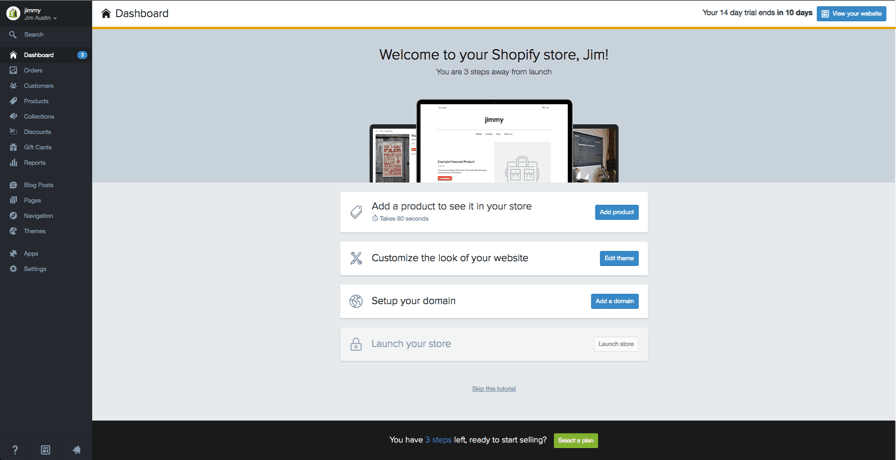
In the backend, there is inventory management, among other tools, like menus, that will impact how your website is built. However, the majority of the store building will take place inside the theme.
Most themes are pseudo-drag-and-drop tools that let you move elements like photos, text blocks, and other content to different places. Some themes are more menu-centric and are built in less visually appealing ways.
Almost all of Shopify’s approved themes are easy to use, with a low learning curve.
Inside the themes, you’ll also pick your colors, fonts, and other necessary settings.
Shopify Themes
Paying for Shopify is already a significant expense for many new entrepreneurs. Fortunately, you can choose between a handful of free themes that can truly make a beautiful website.

Of course, paid themes offer greater functionality, and you have tons of premium themes to choose from. Several developers create themes for hosting services such as Shopify, WordPress, and BigCommerce.
Shopify eCommerce Features
Shopify is as feature-rich as it gets. Diving into a free trial can show all of the different options, but here are a handful.
Capabilities
Something to think about when creating your store is what happens if your store succeeds to an insane degree? Rapid growth can create scalability challenges. Can your hosting service keep up with your meteoric rise?
Shopify grows with you. The cheapest plan offers everything a beginner could want, and their most expensive plan allows a fast riser to grow into a blossoming company.
There are cost-saving features, advanced report builders, discounts, and even enterprise-grade solutions for high-volume merchants. If you’re curious about the best merchant services in Canada, take a look at our guide.
Multi-channel Selling – Sell On Any/Every Platform
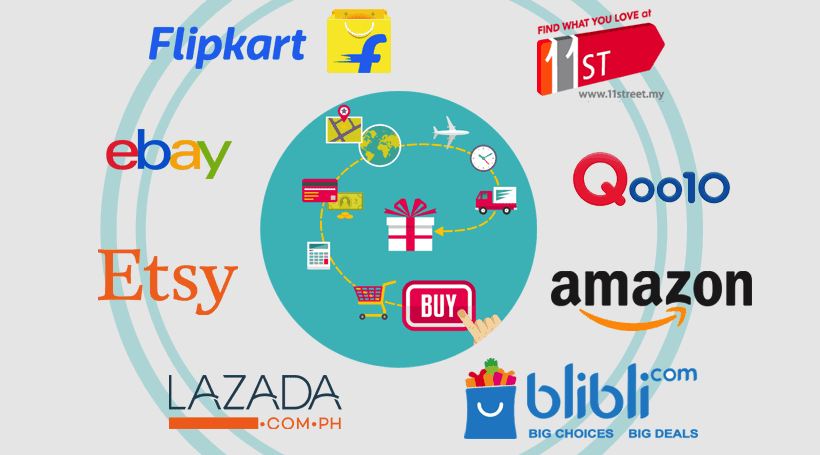
If you only showcase your products on your website, you aren’t putting much effort into it. People are shopping on Amazon, eBay, Etsy, Facebook, and Instagram just as often as they are on e-commerce websites.
Shopify lets you sell on 20 other channels, making it easy to reach potential customers anywhere on the internet.
If you’re serious about building a viable e-commerce store, you just can’t beat this type of reach.
Inventory Management
Many stores have a large product catalog. It can be scary to organize everything on your website in a way that makes sense to customers while also juggling inventory from different suppliers. That is a lot to worry about.
For a store where some products come from Amazon’s fulfillment centers, others from a print-on-demand service, others from a drop-shipping provider, and still more from your grandpa’s basement, inventory management can quickly become a headache.
Shopify has you covered, letting you list products from yourself and any other fulfillment center you may be using.
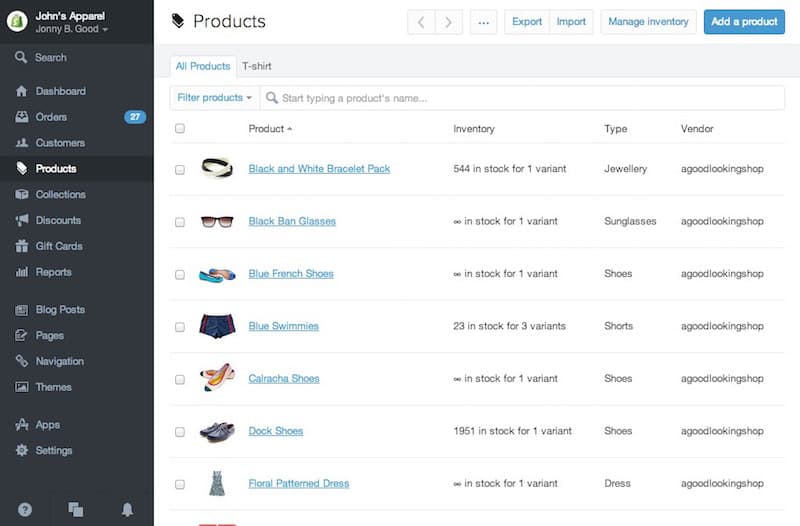
Each product can be set to be fulfilled from anywhere, even within the same collection.
Reports
To be a successful store owner, you will need to understand data and sales analytics so you can learn from them and improve.
Shopify makes this effortless. It comes with charts that provide useful information, such as total sales over time, conversion rates, total store visits, average order value, repeat customer rate, and total orders.
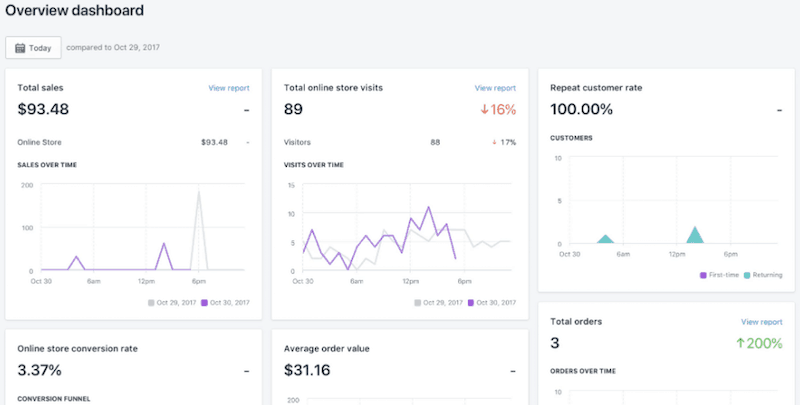
Other aspects, like where people are finding your site, are also available. If 28 people came to your website from Pinterest that day, Shopify will let you know.
Mobile Optimization

It is likely that 7 out of 10 of your clients will view your e-commerce store on a mobile device. Unfortunately, many platforms are built for desktop use.
Here are two fun e-commerce website statistics for you:
- Poor mobile design alone is enough for 57% of internet users not to recommend your business to their peers.
- Almost 80% of consumers will stop engaging with your website if the mobile website displays inconveniently.
Shopify knows that people use their phones to shop online and ensures that all themes on its platform are mobile-optimized. They also provide views of your website across desktop, tablet, and mobile.
Other Fun Tools
There are multiple fun features and tools worth mentioning:
- Kit – A marketing automation tool that can send out emails, create ads, post on social media, and send you reminders.
- Burst – Shopify’s stock photo tool that has high quality images that don’t look generic. All the images are free.
- Exchange – Shopify has its own marketplace for stores. If you grow your business and decide you want to sell it, there is a built-in environment to explore.
App Store
Shopify’s app store is growing strong, currently offering around 16,000 apps. This means that the app store will probably have a solution for your issue. Just know, the more specific the problem, the more likely there will be a cost associated with the solution.
Shopify Customer Support
Shopify’s customer service used to be highly lauded, until recently. They had a phone number and easily reachable humans. Now, however, live chat is the only available support unless you have the Plus plan, so keep that in mind.
If you have a common problem or question, the AI chatbot may just have the answer you need without too much fuss. Things like refunds, billing issues, or larger tech problems may be a different story.
Fortunately, Shopify’s knowledge base is full of FAQs and in depth tips. They also offer an academy with free training courses full of videos and frequent webinars. On top of that there are text guides on specific topics that can be read.
One underrated part of Shopify’s general appeal is the community. The forums for Shopify – whether general Shopify, themes, or apps – are always teeming with useful information and help.
Shopify Pricing and Plans Explained
There are certain features that you get with each pricing plan, like SSL encryption, abandoned cart recovery, unlimited number of products, non-stop support, and many others.
Besides those, you might have to pay extra for premium apps or themes, if that’s what you’re looking for. Most of these apps and themes will definitely be worth your while, since they’ll take your shop to the next level.
What Do Others Think of Shopify?
While our Shopify POS review has plenty of accolades and some cons, it’s really helpful to dive into what other users think. Here’s a quick overview of different reviews and opinions from others who have used the platform.
Customer Reviews of Shopify
While the platform offers many helpful features and capabilities, the number one user complaint is its lackluster customer support. When there are issues, it can be very challenging to find a real human to talk to, as most of the time you’re thrust at an AI chatbot instead.
Unfortunately, this is becoming increasingly widespread across services and platforms, so Shopify is hardly unique in its lack of robust customer support.
Other common customer complaints:
- Difficulty cancelling subscriptions.
- Shipping issues.
- Problems getting refunds.
Expert Reviews of Shopify
As for expert Shopify reviews, they seem to come up with lists pretty similar to ours in terms of what they love and what they don’t. There are tons of strong options for building your store, including e-commerce tools and features that are easy for anyone to use.
Where things hit a snag are, once again, customer service and also pricing. For users who are very tech-savvy, they also find that Shopify doesn’t offer the full gamut of granular customizations that other platforms do.
Community Opinions on Shopify
Overall, community discussions, such as on Reddit, tend to highlight the same concerns for potential new Shopify users. Yes, they make it easy to start your own online store. Yes, they have some powerful features and capabilities. However, expenses and poor customer support keep coming up as criticisms.
That doesn’t mean communities and other reviewers don’t have good things to say, however. Commonly lauded aspects of the platform include:
- Very good for beginners.
- Built-in site security.
- Well suited for scaling businesses.
- Plug and play (for the most part).
- Strong integrations and functionality.
- Excellent app library.
Conclusion
While Shopify has some issues to work through (particularly in customer service), it offers a lot for beginners in e-commerce.
Before you decide one way or another, it may be helpful to review some of the platform’s learning resources and tutorials. You can see what to expect in terms of common problems and questions, which will give you a baseline.
The biggest issue seems to be customer service, as all other problems stem from that weakness. If you have confidence in your tech abilities or are willing to fight your way through the customer support AI until you find a real human, there’s really a lot to love about the platform.

Our endorsement of Shopify comes from hours of testing and working with as many e-commerce platforms as possible.
References and image credits:
- Gomanos.com
- WorthThinkers.com
- FiveOcean.net
- VinculumGroup.com
- ForexTribune.com
Shopify News
- Shopify launches new retail hardware called POS Go – Sept 27, 2022 – Currently available for pre-order in the US, this new device resembles a smartphone but with a fully integrated card reader enabling tap, swipe, and chip cards to be used, making it easier than ever for in-store merchants to connect, track, and take payments for their stores.
- Shopify introduces brand new POS – May 4, 2020 – Shopify introduced and launched a brand new POS that’s available with all Shopify plans. This feature sets to help merchants around the globe to adapt and adjust to the new business and market challenges ahead of them.
- Shopify Capital starts in Canada – April 20, 2020 – Shopify Capital is introduced to customers in Canada, as a means of support to businesses in financial need. These money advances will be repaid from future transactions
- Shopify Email Released and free until October – April 15, 2020 – Shopify is making its Shopify Email available for free to all merchants until October 1, 2020. The company recognized the importance of email in communication with the customers, so they decided to offer it to everyone during the pandemic.